Aorto-iliac Occlusive Disease
The aorta is the body's largest artery. It carries blood from your heart, down through your chest and abdomen, then splits low down (near your belly button) into two branches – the iliac arteries – that supply each leg.

Aorto-iliac Occlusive Disease
Aorto-iliac occlusive disease is a narrowing or blockage of the lower aorta and/or the iliac arteries – the branches of the aorta that carry blood into your legs. It is a form of peripheral arterial disease (PAD).
It develops when plaque (a build-up of cholesterol and calcium) collects in the artery walls and hardens them – a process called atherosclerosis. As the arteries narrow, less blood and oxygen reach your legs, which can cause pain when you walk. In severe, untreated cases it can lead to sores (ulcers), gangrene, or even loss of a limb, though this is uncommon.
The good news is that it can usually be treated – with lifestyle changes, medication, or a procedure to restore blood flow.

Symptoms
Claudication
The usual first symptom is cramp, ache or tiredness in your buttocks, thighs or calves when you walk, which eases when you rest (called intermittent claudication). As the disease progresses, the pain comes on after shorter distances.
Erectile dysfunction
In men, reduced blood flow to the pelvis can cause erectile dysfunction – often at an early stage, together with buttock claudication and weak groin pulses (Leriche syndrome).
Rest pain
In more advanced disease, you may feel pain in your feet or toes even at rest.
Warning signs that it has advanced:
Severe pain, coldness or numbness in the leg
Sores on the toes, heels or lower legs
Dry, cracked skin that may become infected
Weakened leg muscles
Gangrene (tissue death)
These usually mean the arteries are blocked in more than one place, and need prompt treatment to avoid losing the limb.
Causes
The main cause is atherosclerosis (hardening of the arteries). Things that raise your risk:
Smoking
Diabetes
High cholesterol
High blood pressure
Being overweight
A family history of heart or artery disease
Rarely, inflammation of the artery wall (Takayasu's arteritis, usually in young women) is the cause.
Tests
I start by asking about your symptoms and health, and feeling the pulses in your legs.
Ankle-brachial pressure index (ABPI)
A simple comparison of the blood pressure at your ankle with that in your arm, using a cuff and a hand-held ultrasound (Doppler). A lower ankle reading points to narrowed leg arteries. It confirms the problem but does not show exactly where the blockage is.
Doppler ultrasound (duplex)
A painless scan that shows blood flow and pinpoints which arteries are narrowed.
Angiography
Contrast dye and x-rays map the exact site and pattern of the blockages, usually when a procedure is being planned.
Treatment Options
Lifestyle Changes
Stopping smoking is the single most important thing you can do – tobacco directly damages your arteries.
A structured walking programme is the most effective non-surgical treatment for claudication: walking regularly, ideally a supervised programme most days of the week, trains your legs to walk further with less pain. Keeping to a healthy weight and eating a Mediterranean-style diet (vegetables, fruit, whole grains, fish, olive oil and nuts) also help slow the disease.
If you have diabetes, good blood-sugar control and careful foot care are important, because reduced feeling in the feet makes sores more likely. A podiatrist can help.
Medication
Medication supports these measures rather than replacing them. An antiplatelet (aspirin or clopidogrel) lowers the risk of heart attack, stroke and clots, and a statin lowers cholesterol; your blood pressure and blood sugar are also treated to protect your arteries. In selected patients, a low dose of the blood thinner rivaroxaban (2.5 mg twice a day) added to aspirin further lowers the risk of heart attack, stroke and serious leg complications, at the cost of more bleeding (COMPASS and VOYAGER PAD trials). Cilostazol may modestly improve how far you can walk; it must not be used if you have heart failure.
Intervention
If the disease is severe, or does not improve with the steps above, a procedure may be needed to restore blood flow. The best option depends on where the blockages are and how extensive they are.
Forms of Intervention
Angioplasty with or without stent
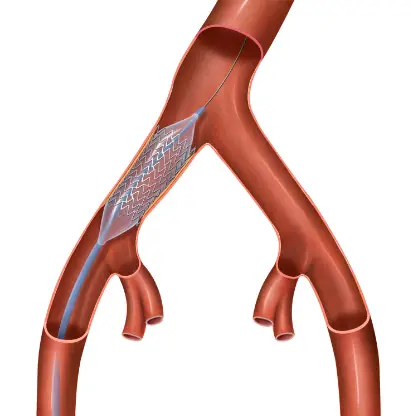
A thin tube (catheter) is passed from an artery in your leg to the narrowed area. A small balloon is inflated to widen the artery, and a small mesh tube (stent) may be left in place to hold it open. Blood then flows more freely.
Endarterectomy
Through an incision in your leg or groin, I remove the plaque from the lining of the artery, leaving it open and restoring blood flow.
Bypass surgery
A fabric tube (graft) is used to route blood around the blocked section – for aorto-iliac disease, usually a Y-shaped graft from the aorta to the arteries in each groin. It is a durable operation, and most grafts are still working well many years later.
References
European Society for Vascular Surgery (ESVS) 2024 Clinical Practice Guidelines on Asymptomatic Lower Limb Peripheral Arterial Disease and Intermittent Claudication. Eur J Vasc Endovasc Surg, 2024.
Society for Vascular Surgery Clinical Practice Guideline on the Management of Intermittent Claudication: Focused Update. J Vasc Surg, 2025.
Anand SS, Bosch J, Eikelboom JW, et al. Rivaroxaban with or without aspirin in patients with stable peripheral or carotid artery disease (COMPASS). Lancet 2018;391(10117):219–229. doi:10.1016/S0140-6736(17)32409-1
Bonaca MP, Bauersachs RM, Anand SS, et al. Rivaroxaban in Peripheral Artery Disease after Revascularization (VOYAGER PAD). N Engl J Med 2020;382(21):1994–2004. doi:10.1056/NEJMoa2000052


 Postoperative Protocol - Aorta-Bifemoral Bypass
 Patient Roadmap for Aortabifemoral Bypass Surgery
 Aorta-Bifemoral Bypass - Discharge Protocol
 Aorta-Bifemorale Omleiding - Ontslagprotokol - Afrikaans
Our Services
Open Arterial Procedures
Standard open surgical procedures to reconstruct blood flow to the legs.
Aorto-bifemoral bypass
Iliofemoral bypass
Femoral endarterectomy
Endovascular Procedures
Less invasive procedures performed from inside the blood vessels, through small punctures in the groin or arm.
Aortic angioplasty and stenting
Iliac artery angioplasty and stenting
Mesenteric, renal and subclavian artery angioplasty
Hybrid Procedures
Open and endovascular techniques combined in one operation – for example, a groin endarterectomy together with iliac artery stenting.
If you have any problems with any of these conditions, please contact your General Practitioner, or your Vascular Surgeon. If you live in Pretoria and have not seen a Vascular Surgeon before, you are more than welcome to contact our rooms for a formal consultation.
This website offers general information about vascular conditions for patients and their families. It is not personal medical advice and cannot replace an examination by your own doctor or a vascular surgeon. The information may not apply to your situation, even if you have the same diagnosis. If in doubt, consult your doctor.
In a medical emergency, call 10177 (ambulance) or 112 from a cellphone, or go to your nearest emergency department – do not wait for our rooms to call you back. Our rooms are open Monday to Friday, 08:00–16:00 (09:00–16:00 from May to September): 012 335 8651.
Contact us
Tel: 012 335 8651 · Email: [email protected]